
Chest Tightness at Night: Possible Causes and When to Worry
Disclaimer: This article is for general information only and isn’t medical advice or a diagnosis. If you have severe symptoms or think it may be an emergency, call your local emergency number.
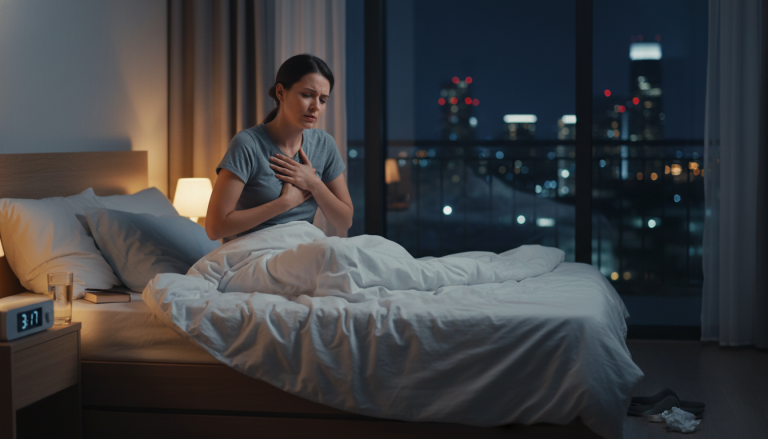
You’re finally in bed, scrolling your phone one last time, when it hits: tight chest, sudden awareness of your heartbeat, and the thought, “Am I dying or is this just anxiety?”
If chest tightness keeps showing up at night just as everything goes quiet, you are not the only one. It’s common, it’s scary, and it deserves attention, but it doesn’t always mean you’re in immediate danger.
In this guide, we’ll break down possible reasons your chest feels tight at night, when it might be anxiety, when it might be your heart, lungs, or something else entirely, and what to do next. Let’s make sense of it calmly.
What Does “Chest Tightness at Night” Actually Feel Like?
People describe chest tightness in very different ways, for example:
- “Like someone is sitting on my chest.”
- “A band squeezing around my ribs.”
- “Pressure in the middle of my chest when I lie down.”
- “Heaviness plus a burning feeling after eating.”
- “A weird tightness that makes me want to take a deep breath.”
You might notice it mostly when lying flat in bed, when you’re about to fall asleep or just waking up in the night, or along with symptoms like shortness of breath, palpitations, heartburn, cough, or anxiety. The way you’d describe the feeling (pressure, burning, stabbing, squeezing) gives big clues about what’s going on.
Big-Picture Causes of Chest Tightness at Night
Chest tightness is a symptom, not a diagnosis. Some common categories of causes include:
- Heart-related issues (like angina or, rarely but seriously, a heart attack)
- Lung issues (asthma, pneumonia, pulmonary embolism)
- Reflux and digestive problems (GERD/acid reflux, esophageal spasm)
- Muscle and rib issues (strained chest muscles, costochondritis)
- Anxiety, panic, and hyperventilation
- Sleep-related breathing problems (like sleep apnea)
Some of these are uncomfortable but not immediately dangerous. Others are true emergencies. We’ll walk through each and flag red-flag symptoms where you should stop reading and seek urgent help. Nighttime chest tightness has many possible causes. The context and extra symptoms are everything.
1. Heart Causes: When Should You Worry About Your Heart?
Nighttime is when you finally notice body sensations you were too busy to feel during the day. But there are real heart conditions that can cause chest pressure or tightness, especially if your heart is under strain.
Possible heart-related causes include:
- Angina – chest discomfort when the heart muscle isn’t getting enough blood.
- Heart attack (myocardial infarction) – when blood flow to part of the heart is blocked.
- Pericarditis – inflammation of the sac around the heart, sometimes worse when lying down.
Typical features that raise concern for a heart cause include pressure, squeezing, or heaviness in the center or left side of the chest; pain or discomfort that spreads to the arm, jaw, neck, or back; shortness of breath; nausea, breaking out in a cold sweat, or feeling faint; and symptoms triggered by physical effort or emotional stress and relieved by rest. Heart symptoms don’t always follow the textbook, especially in women, older adults, and people with diabetes, but new, intense, or worsening chest tightness should never be ignored.
Heart-Related Red Flags: Don’t Wait
Get emergency help right away (call 911 or your local emergency number) if you notice:
- Sudden chest pressure or tightness that lasts more than a few minutes or keeps coming back
- Chest discomfort with shortness of breath, sweating, nausea, or feeling like you might pass out
- Chest pain that radiates to arm, back, jaw, or neck
If your first thought is “This feels really wrong,” or it’s the worst chest pain you’ve ever had, treat it as an emergency.
2. Lung and Breathing Causes: Asthma, Clots, Infections
Your lungs and airways can absolutely cause chest tightness at night.
Asthma
Asthma symptoms often worsen at night, including chest tightness, wheezing (whistling when breathing out), nighttime coughing, and feeling like you can’t get air in or out easily. Triggers can include allergens in the bedroom (dust mites, pet dander), cold air, or respiratory infections. Poorly controlled asthma can lead to frequent nighttime symptoms.
Seek urgent care if you have asthma and you’re struggling to talk in full sentences, your rescue inhaler isn’t helping, or your lips or fingertips look bluish.
Pulmonary Embolism (Blood Clot in the Lung)
A pulmonary embolism is a blood clot that travels to the lungs. It can cause sudden sharp chest pain or tightness that may worsen with deep breaths, sudden shortness of breath, fast heart rate, coughing (sometimes with blood), and feeling lightheaded or faint. This is an emergency.
Pneumonia or Other Lung Infections
Lung infections can cause chest pain or pressure, cough (often with phlegm), fever and chills, and shortness of breath. Night can feel worse because you’re lying flat and everything in your lungs is settling. If chest tightness comes with wheezing, cough, fever, or sudden shortness of breath, think lungs and get evaluated quickly.
3. Acid Reflux and GERD: The Chest Tightness That Masquerades as Heart Trouble
Your stomach can sometimes mimic a heart problem. With acid reflux or GERD (gastroesophageal reflux disease), stomach acid flows back into the esophagus, especially when you lie down.
Common clues it might be reflux include a burning feeling behind the breastbone (heartburn), chest discomfort or tightness after eating or when lying flat, sour taste in the mouth or feeling of fluid coming up, and symptoms that are worse after large, spicy, fatty, or late-night meals.
At night, gravity is no longer helping keep stomach contents down, and many people eat dinner late and lie down soon afterward.
Strategies that sometimes help include avoiding large or heavy meals within three hours of bedtime, elevating the head of your bed slightly, limiting trigger foods (spicy, acidic, fried, chocolate, caffeine, alcohol), and talking to a clinician about antacids or other reflux medications. If chest tightness shows up after eating and feels like burning that gets worse when lying down, reflux is a strong suspect, but heart issues still need to be ruled out if you’re not sure.
4. Muscle, Joint, and Nerve Causes: When It’s Your Chest Wall, Not Your Heart
Your chest is full of muscles, cartilage, and joints. These can hurt or feel tight, especially at night when you’re finally still enough to notice.
Common examples include muscle strain from heavy lifting, new workouts, or even long days at a desk, and costochondritis, which is inflammation of the cartilage where ribs meet the breastbone.
Clues it’s more likely musculoskeletal include pain or tightness that gets worse when you press on a specific spot, pain that changes with movement, twisting, lifting, or deep breaths, and symptoms you can link to a recent injury, strain, or new exercise. This kind of chest discomfort can still feel intense, but it’s usually not coming from the heart or lungs. If touching or moving your chest changes the pain a lot, your chest wall may be the main culprit.
5. Anxiety, Panic Attacks, and the Night-Time Spiral
Many people wonder whether anxiety can cause chest tightness at night. It absolutely can. When you’re anxious or having a panic attack, your body’s “fight-or-flight” system kicks in. Breathing gets faster and shallower, muscles (including chest muscles) tighten, and the heart may beat faster or harder. This combination can create chest tightness or pressure, a need to take a deep breath all the time, and a feeling of not getting enough air, even if oxygen levels are normal.
At night, there are fewer distractions, so you may focus more on bodily sensations. Worries can get louder as the day winds down, and some people experience nocturnal panic attacks that wake them from sleep.
Signs Chest Tightness May Be Related to Anxiety
- It appears during or after periods of intense worry or stress
- You’ve had panic attacks or strong anxiety before
- Medical tests (like ECG, blood work, chest X-ray) haven’t shown heart or lung disease
- The tightness eases when you calm down or distract yourself
Ways to Handle Anxiety-Related Chest Tightness in the Moment
These don’t replace medical evaluation, but they can help while you’re waiting for care or once serious conditions have been ruled out.
-
Slow-breathing reset
- Inhale through your nose for a count of 4
- Hold for a count of 4
- Exhale slowly through your mouth for a count of 6–8
- Repeat for 1–3 minutes
-
Drop your shoulders
- On an exhale, consciously relax your shoulders and jaw
- Many people carry tension there without realizing it
-
Name 5 things
- Look around and name 5 things you can see, 4 you can touch, 3 you can hear, 2 you can smell, 1 you can taste
- This can pull you out of the anxiety spiral and back into the present
If anxiety is a frequent culprit, consider talking with a mental health professional. Therapy, lifestyle changes, and sometimes medication can reduce both anxiety and physical symptoms like chest tightness. Anxiety can absolutely cause real chest sensations, but you should never assume it’s “just anxiety” without being checked at least once.
6. Sleep Apnea and Nighttime Breathing Problems
Obstructive sleep apnea is a condition where your airway repeatedly collapses or narrows during sleep, causing breathing to stop and start.
Possible signs include loud snoring with pauses in breathing (often noticed by a partner), waking up gasping or choking, morning headaches, feeling unrefreshed despite a full night in bed, and chest tightness or discomfort, especially on waking.
Untreated sleep apnea can raise the risk of high blood pressure, heart disease, stroke, and more, so it’s worth taking seriously. Diagnosis usually involves a sleep study, and treatments can include weight management, CPAP machines, oral appliances, or other approaches depending on the cause. If your chest tightness at night comes with heavy snoring, gasping, or extreme daytime sleepiness, ask a clinician about sleep apnea.
When Is Chest Tightness at Night an Emergency?
You should treat chest symptoms with respect. Seek emergency medical care (911 or local emergency number) if chest tightness or pain is sudden, severe, or feels crushing or heavy; if it lasts more than a few minutes or keeps coming back; or if you also have shortness of breath, sweating, nausea or vomiting, pain spreading to your arm, back, jaw, or neck, or feeling lightheaded, weak, or like you might pass out. This is especially important if you have a history of heart disease, blood clots, or major risk factors like high blood pressure, diabetes, smoking, high cholesterol, or strong family history.
If you’re not sure whether it’s serious, it’s better to get checked and be told it’s okay than wait on something dangerous. Chest tightness combined with shortness of breath and feeling unwell overall is a reason not to self-diagnose and to seek urgent care.
When to See a Doctor Soon (Not Necessarily Tonight)
Even if it doesn’t feel like an emergency, you should book an appointment if you have repeated episodes of chest tightness at night, symptoms are new for you or changing over time, over-the-counter remedies (like antacids or inhalers, if you use them) aren’t helping, or you’re avoiding sleep or feeling constantly anxious about nightly symptoms.
A clinician may ask detailed questions about your symptoms and triggers, check blood pressure, heart rate, and oxygen level, and order tests like an ECG, blood tests, chest X-ray, or stress test. They may consider reflux, asthma, anxiety, sleep apnea, or heart problems based on your exam and history. Persistent or unexplained chest tightness deserves a proper workup; you don’t have to just live with it.
Practical Things You Can Track Before Your Appointment
If you want to make your visit more useful, show up with data. For the next few nights, jot down:
-
Timing
- What time does the chest tightness start?
- Does it wake you from sleep, or start as you’re falling asleep?
-
Position
- Is it worse lying flat on your back?
- Does it improve if you sit up or prop yourself on pillows?
-
Food and drinks
- What did you eat and drink in the 3–4 hours before bed?
- Any late caffeine, alcohol, or heavy or spicy foods?
-
Activities and stress
- Was it a particularly stressful day?
- Any heavy exercise or lifting earlier?
-
Other symptoms
- Shortness of breath, cough, wheezing
- Palpitations
- Heartburn or sour taste
- Sweating, dizziness, nausea
Bring this mini “symptom diary” to your appointment. It helps your clinician spot patterns much faster. A simple notebook or notes app can shave weeks off the trial-and-error phase of figuring out what’s going on.
What You Shouldn’t Do
A few final no-go’s:
- Don’t self-diagnose chest pain over the internet. Use online info to ask better questions, not to rule out emergencies.
- Don’t ignore new or worsening symptoms just because “it happened before and I survived.” Your body can change.
- Don’t assume it’s “just anxiety,” especially if you’ve never had a full medical check for chest symptoms.
The Bottom Line on Chest Tightness at Night
Chest tightness at night can come from many sources: heart, lungs, reflux, muscles, anxiety, sleep apnea, and more. Some are relatively mild. Others are urgent. You don’t have to figure it all out alone.
Use this guide to notice key patterns and triggers, recognize true red-flag symptoms that need emergency care, and prepare questions and notes for your healthcare visit. Getting checked out is not overreacting; it’s being responsible with the only heart and lungs you’ve got.
Sources
- Mayo Clinic – Chest pain: First aid, causes, and when to see a doctor (symptoms, red flags) https://www.mayoclinic.org/diseases-conditions/chest-pain/symptoms-causes/syc-20370838
- Mayo Clinic – Heart attack: Symptoms and causes (heart-related causes, emergency signs) https://www.mayoclinic.org/diseases-conditions/heart-attack/symptoms-causes/syc-20373106
- American Heart Association – Warning signs of a heart attack (when to call 911) https://www.heart.org/en/health-topics/heart-attack/warning-signs-of-a-heart-attack
- National Heart, Lung, and Blood Institute – Asthma (nighttime asthma, symptoms, triggers) https://www.nhlbi.nih.gov/health/asthma
- National Heart, Lung, and Blood Institute – Pulmonary embolism (symptoms and risk) https://www.nhlbi.nih.gov/health/pulmonary-embolism
- National Institute of Diabetes and Digestive and Kidney Diseases – GERD (acid reflux causes and nighttime symptoms) https://www.niddk.nih.gov/health-information/digestive-diseases/acid-reflux-gerd-adults
- American Academy of Sleep Medicine – Obstructive sleep apnea (symptoms, health risks, diagnosis) https://sleepeducation.org/sleep-apnea/obstructive-sleep-apnea/
- National Institute of Mental Health – Anxiety disorders (physical symptoms of anxiety and panic) https://www.nimh.nih.gov/health/topics/anxiety-disorders
Leave a Reply