
Why Is My Heart Racing Right Now?
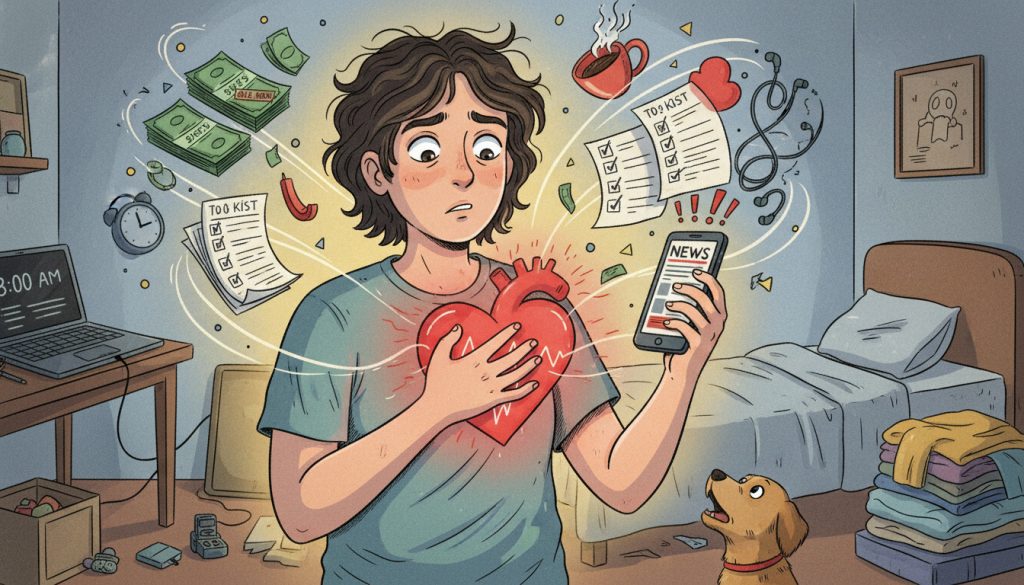
You are sitting there minding your business when suddenly your heart decides to audition for a drum solo. No warning. No treadmill. Just boom-boom-boom in your chest.
If you are thinking, “Why is my heart racing right now — and should I be freaking out?”, this will walk through what might be going on, when it is usually harmless, when it is not something to ignore, and what you can do in the moment.
Quick note: This is for education, not diagnosis. If something feels seriously wrong, do not overthink it — get help.
What Does “Heart Racing” Actually Mean?
People describe a racing heart in a bunch of ways:
- Pounding or thudding in your chest
- Heartbeat that feels faster than normal
- Fluttering, skipping, or “flip-flop” sensations
- Feeling your pulse in your neck, ears, or chest
Medically, a resting heart rate over about 100 beats per minute is called tachycardia. But you may feel like your heart is racing even below that if you are not used to noticing your heartbeat.
Takeaway: “Heart racing” is usually about either speed (fast), force (pounding), rhythm (irregular) — or all three.
Common (and Surprisingly Normal) Reasons Your Heart Is Racing Right Now
Here are some causes that sound dramatic but are often very fixable.
1. Stress, Anxiety, or a Mini Adrenaline Surge
When you are anxious, your body flips into fight-or-flight mode. Your brain signals your adrenal glands to release adrenaline. That hormone:
- Speeds up your heart rate
- Makes your breathing faster or shallower
- Can cause chest tightness, sweating, or a “wired” feeling
You might notice this:
- Right after a stressful text, email, or conflict
- While you are doomscrolling bad news
- Out of nowhere — because your brain revisited something stressful
Panic attacks can make your heart race, pound, or feel like it is skipping along with dizziness or a sense of “I am about to die” — even though many people are medically fine afterward.
Quick self-check:
- Has anything stressful happened today?
- Did your heart start racing around the same time as feeling worried, scared, overwhelmed, or upset?
If yes, anxiety is high on the suspect list.
Takeaway: Your body might not be broken; it might just be reacting (loudly) to stress.
2. Caffeine, Energy Drinks, or Stimulants
Coffee, energy drinks, pre-workout, certain teas, chocolate, and some medications can all crank up your heart rate.
Common culprits:
- Large coffees or multiple cups back-to-back
- Energy shots or drinks
- Strong pre-workout powders
- Decongestants (like some cold medicines) and ADHD stimulants
Some people are more sensitive to caffeine and stimulants than others. Even a “normal” amount can cause:
- Jitters or shakiness
- Racing heart
- Feeling wired but tired
Questions to ask yourself:
- Did you have caffeine or an energy drink in the past 4–6 hours?
- Did you increase your dose recently (stronger coffee, new pre-workout, new pill)?
Takeaway: Your heart may be reacting to what is in your cup, not what is in your soul.
3. Dehydration or Not Eating Enough
Low fluid intake or low blood sugar can push your body into “compensate mode,” which often means:
- Faster heart rate
- Lightheadedness or dizziness when you stand up
- Weakness or shakiness
This can happen if you:
- Have not eaten in many hours
- Are on a new diet and barely eating carbs
- Spent time in heat, sweated a lot, or exercised and did not rehydrate
Fast check:
- When was your last real meal?
- How much water have you had today, really?
Takeaway: Sometimes your heart is racing because your body is quietly whispering, “Water and food. Now, please.”
4. Normal Response to Movement or Position
If you just:
- Walked up stairs
- Rushed across the room
- Stood up quickly after sitting or lying down
Your heart rate will naturally rise to pump blood where it needs to go. If you are out of shape, tired, or recovering from illness, you may notice this more.
There is also something called orthostatic intolerance — where standing up makes your heart beat faster and you feel a bit off — but that is something a doctor would need to evaluate if it is frequent.
Takeaway: If your heart speeds up briefly with movement and quickly settles, that can be normal.
5. Illness, Fever, or Infection
When you are sick — even with something like the flu or a viral infection — it is common for your heart rate to go up.
You might notice:
- Fever or chills
- Cough, sore throat, or body aches
- Feeling weak, wiped out, or just “off”
Your heart beats faster to help your body fight infection and move oxygen more quickly.
Takeaway: Feeling sick plus a racing heart is not rare, but it is still something to mention to a healthcare provider, especially if you feel very unwell.
When a Racing Heart Might Be More Serious
Here are situations where you should not just shrug it off.
Red-Flag Symptoms: Do Not Ignore These
You should seek immediate medical help (ER or emergency services) if your heart is racing and you have:
- Chest pain, pressure, squeezing, or discomfort
- Shortness of breath that is new or severe
- Fainting or feeling like you are about to pass out
- Pain in your jaw, arm, back, or neck
- A feeling of impending doom or something being very wrong
- Confusion, trouble speaking, or weakness on one side of the body
Those can be signs of something serious like a heart attack, dangerous heart rhythm, stroke, or another emergency.
Also get urgent care if:
- Your heart rate is very high and not slowing down at rest (for example, staying above 120–130 beats per minute for a while when you are just sitting)
- The rhythm feels wildly irregular (not just a single skipped beat here or there)
- You have a known heart condition and this feels very different from your usual
Takeaway: If you are asking, “Is this an emergency?” and your gut says “maybe,” it is better to get checked.
Could It Be a Heart Rhythm Problem (Arrhythmia)?
Sometimes a racing heart comes from an arrhythmia — an abnormal heart rhythm.
Some examples you might hear from a doctor:
- Supraventricular tachycardia (SVT): Sudden episodes of very rapid heart rate that can start and stop abruptly.
- Atrial fibrillation (AFib): Irregular, often fast heartbeat that may feel like fluttering or pounding.
- Premature beats (PACs, PVCs): Extra beats that can feel like flutters, thumps, or “skipped beats.”
These can be benign (more annoying than dangerous) or potentially serious — especially if you have other heart disease, are older, or have other medical conditions.
Only a healthcare professional with tools like an ECG (EKG) or heart monitor can tell you for sure what type of rhythm you have.
Signs it is worth getting evaluated soon:
- Repeated episodes of heart racing for no obvious reason
- Episodes that last many minutes to hours
- Family history of sudden cardiac death or serious arrhythmias
- You feel weak, dizzy, or breathless when it happens
Takeaway: A racing heart can be harmless, but if it is frequent, intense, or worrying, a proper workup is the safe move.
What to Do Right Now If Your Heart Is Racing
If you are not having severe symptoms like chest pain, fainting, or trouble breathing, here are steps you can try to calm things down and gather useful information.
1. Check the Basics
- Sit or lie down somewhere safe. Do not keep walking around or driving if you feel off.
- Check your pulse on your wrist or neck, or use a smartwatch or fitness tracker if you have one.
Note roughly:
- How fast it seems (for example: “around 110 bpm”)
- Whether it feels regular (steady) or irregular (all over the place)
- What you were doing right before it started
Write this down or put it in your phone. It is very useful for a doctor later.
2. Try a Slow-Breathing Reset
You can help your nervous system shift gears using your breath.
Try this for 1–3 minutes:
- Inhale gently through your nose for a count of 4.
- Hold your breath for a count of 4.
- Exhale slowly through pursed lips for a count of 6–8.
- Repeat.
If holding your breath feels uncomfortable, skip the hold and just inhale for 4 and exhale for 6–8.
Often, this can lower anxiety and help your heart rate drift downward if the cause is stress or adrenaline.
3. Remove Obvious Triggers
Ask yourself:
- Have I had caffeine or energy drinks recently? If so, no more today.
- Am I overheated? Move to a cooler place and remove extra layers.
- Am I dehydrated? Sip water slowly.
- Did I skip eating? Have a light, balanced snack if it is safe for you.
4. Try Grounding Your Mind
Because anxiety and heart racing feed each other (your heart races, you panic, your heart races more), grounding can help break the loop.
You can try the 5–4–3–2–1 technique:
- Name 5 things you can see
- 4 things you can feel
- 3 things you can hear
- 2 things you can smell
- 1 thing you can taste
Giving your brain a specific task can lower that spiraling “what if?” chatter.
5. Decide What Level of Care You Need
After a few minutes of calm breathing and sitting:
- If your heart rate is still very high, you feel worse, or you have any red-flag symptoms, seek urgent or emergency care.
- If it is slowing down, you feel more normal, and there are no other serious symptoms, it is still wise to mention this to your primary care provider and ask if you need an ECG or heart monitor.
Takeaway: Calm the body, gather data, then decide whether to ride it out or get seen — but do not ignore your instincts.
How to Reduce Future “Why Is My Heart Racing?” Moments
You cannot control everything, but you can lower how often this happens or how intense it feels.
1. Tame the Stimulants
- Set a caffeine cutoff time (for example, none after 2 p.m.).
- Track how you feel after coffee, energy drinks, or pre-workout.
- Consider cutting back for a week or two to see if racing episodes drop.
2. Support Your Body’s Basics
- Hydration: Carry a water bottle and actually drink from it.
- Regular meals: Do not go many hours running only on caffeine.
- Sleep: Aim for something in the 7–9 hour range if you can.
Your heart likes boring consistency.
3. Build Stress Valves Into Your Day
You do not have to become a meditation expert, but even small practices help:
- 5–10 minutes of slow breathing or a guided meditation
- Short walks outside
- Stretching or light yoga
- Journaling or brain-dumping your worries
The lower your baseline stress, the less often your body overreacts with adrenaline dumps.
4. Get a Proper Medical Checkup
Especially if:
- You are having repeated heart-racing episodes
- You have a history of heart issues, thyroid problems, anemia, or other medical conditions
- You are on medications that might affect heart rate
A provider might:
- Do blood tests (for anemia, thyroid function, electrolytes, and more)
- Order an ECG (EKG)
- Give you a wearable heart monitor
It is not about being dramatic — it is about ruling out the big stuff so your brain can stop going to worst-case scenarios every time your chest thumps.
Takeaway: Small daily habits plus a good checkup can reduce both the episodes and the anxiety around them.
When Googling “Heart Racing Right Now” Makes Everything Worse
The pattern often goes like this: your heart starts pounding, you search your symptoms online, and within a few clicks, you are convinced it is the worst possible thing.
Information is helpful until it tips into panic fuel.
If you catch yourself doom-searching:
- Step away from the screen for a bit.
- Focus on what you actually know: your symptoms, your history, and what your body is doing right now.
- Use that energy to either calm yourself with the exercises above or call a real human professional who can evaluate you.
Takeaway: The internet is not your cardiologist. Use it to get informed, not terrified.
The Bottom Line: What Your Racing Heart Might Be Saying
If your heart is racing right now, it could be:
- A normal reaction to stress, caffeine, dehydration, or movement
- A sign your body wants basics like rest, food, or water
- A symptom of anxiety, panic, or being chronically on edge
- Occasionally, a warning sign of a heart rhythm issue or another medical problem
You do not have to figure it all out alone. If you are scared, symptoms are intense, or something just feels off in a serious way, seeking medical care is not overreacting — it is being careful with the only heart you have.
And if this turns out to be “just” stress or a benign rhythm quirk, that is still valuable information. It means you can work on triggers, build calming habits, and learn your body’s patterns.
So take a deep breath in, a slow breath out, and if you are in doubt about your racing heart, reach out to a professional who can check you properly. You are not strange; you are just a human with a very dramatic internal drum section.
Leave a Reply