Is This Anxiety Or Something Physical?
You’re lying in bed.
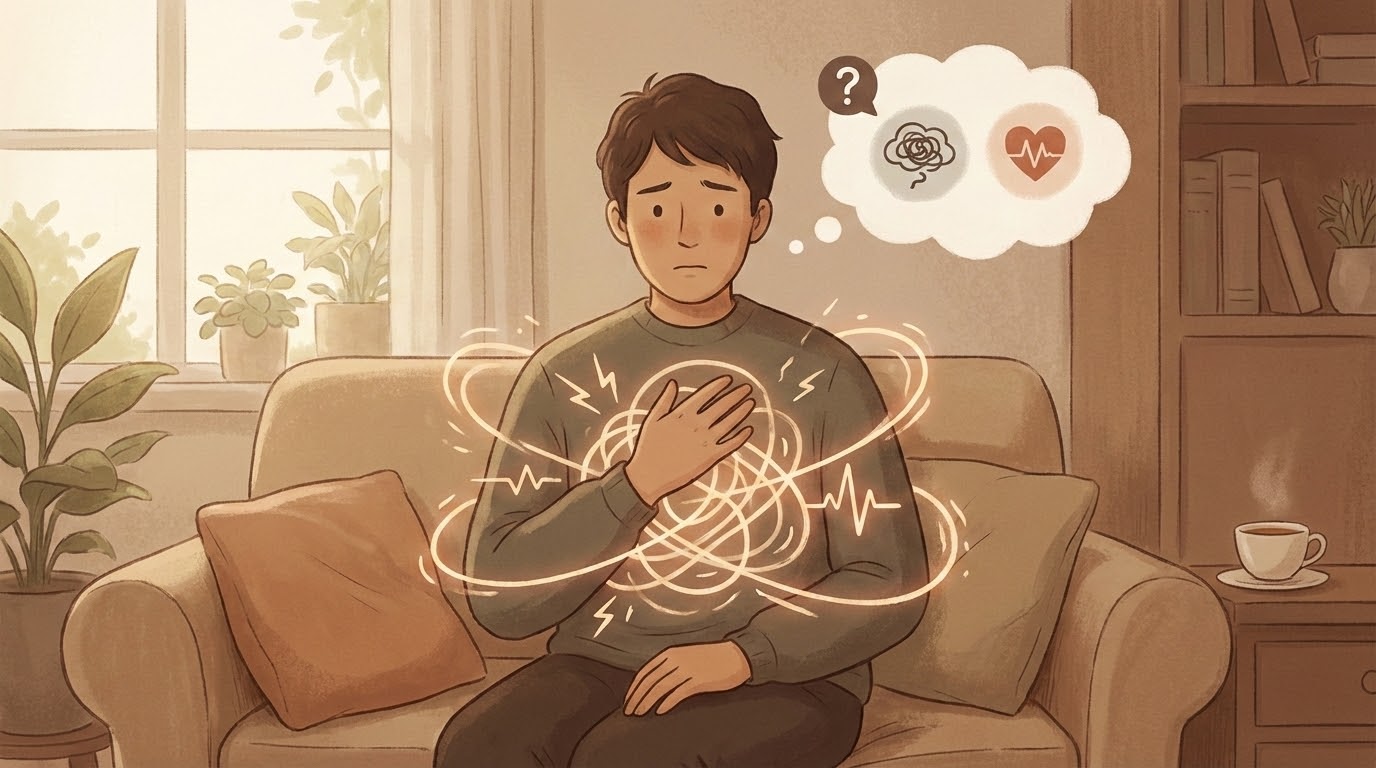
Your heart is racing, your chest feels weird, you’re slightly dizzy, and your brain whispers: “Is this just anxiety… or am I actually dying?”
You Google. Bad idea. Now you are dying — in ten different ways — according to the first page of search results.
Let’s slow this down.
This post will walk you through:
- How anxiety can create very real physical symptoms
- Clues that suggest anxiety vs something more medical
- When you should not assume it’s “just anxiety”
- Practical steps to take today (besides doomscrolling)
This is not a substitute for a doctor, therapist, or emergency care. But it is a guide to help you make sense of what your body might be telling you — and to know when to get help.
Why Anxiety Feels So Physical (You’re Not Imagining It)
Anxiety isn’t just a “thought problem.” It’s a full-body alarm system.
When your brain thinks there’s a threat (real or imagined), it flips on your fight-or-flight response:
- Your heart beats faster to push blood to your muscles
- Your breathing changes (faster or shallower)
- Muscles tense up (jaw, neck, shoulders, stomach)
- Digestion slows down (nausea or urgent bathroom trips)
Even if the “threat” is an email, a memory, or a what-if thought, your body can react the same way.
Common physical symptoms of anxiety can include:
- Racing or pounding heart
- Tight chest or feeling like you can’t get a deep breath
- Dizziness or lightheadedness
- Tingling in hands, feet, face
- Sweaty or shaky
- Nausea, stomach pain, diarrhea, constipation
- Feeling detached or “not real” (derealization)
- Hot flashes or chills
These are real sensations, driven by a real nervous system response.
Quick takeaway: Anxiety can absolutely feel like a physical illness. That doesn’t mean everything is anxiety.
The Core Question: Is It Anxiety Or Something Physical?
Without a medical evaluation, you can’t know for sure. But you can look at patterns and context.
Think of this in three buckets:
- Probably anxiety-related (but still check in with a doctor at some point)
- Needs a non-urgent medical workup
- Drop-everything, get urgent or emergency care
We’ll walk through each.
1. Signs Your Symptoms Might Be Anxiety-Driven
These are green-ish flags that what you’re feeling could be related to anxiety or panic.
A. Symptoms ramp up with stress or certain thoughts
Ask yourself:
- Do these feelings spike before social events, meetings, driving, or conflict?
- Do they show up while you’re worrying about your health, future, relationships, or money?
- Do they calm down when you’re distracted, engaged, or having fun?
When symptoms clearly follow stress, worry, or triggers, anxiety is a strong suspect.
B. They come in waves or “attacks” and eventually pass
Panic attacks typically:
- Build up over minutes
- Peak within about 10–20 minutes
- Slowly ease off afterward (you might feel drained or shaky)
Physical illnesses can also come in waves, but panic episodes often have a pattern: sudden, intense, then gradual calm.
C. You’ve been medically checked and cleared (but still feel awful)
If a doctor has evaluated you — maybe with blood work, ECG, basic exam — and said something like, “We’re not seeing a physical cause,” anxiety or another mental health condition becomes more likely.
This doesn’t mean your symptoms are fake. It means the source is likely your nervous system rather than, say, your heart or lungs.
D. Symptoms are broad and move around
Anxiety symptoms can be weirdly random:
- Head tension one day
- Stomach issues the next
- Then random tingling or shaky hands
Physical conditions tend to be more specific (for example, knee pain in one spot, a rash in one area, consistent chest pain with exertion).
Quick takeaway: If your symptoms are closely linked with worry or stress, come in waves, and you’ve already been medically checked, anxiety is a strong contender.
2. Signs You Need a Non-Urgent Medical Checkup
You should not have to guess alone.
It’s reasonable and smart to see a primary care provider if:
- Symptoms are new and you’ve never been evaluated
- They stick around for weeks instead of minutes or hours
- You notice unintended weight loss or gain
- Your sleep, appetite, or energy have changed significantly
- You have a family history of relevant conditions (heart disease, thyroid disorders, diabetes, etc.)
Conditions like thyroid disorders, anemia, low blood sugar, heart rhythm problems, vitamin deficiencies, perimenopause, or medication side effects can all mimic or worsen anxiety. Getting basic labs, vitals, and a good history can rule out or treat those.
This doesn’t mean it’s “not anxiety.” Physical and mental health often overlap. You can have both a medical issue and anxiety at the same time.
Quick takeaway: If you’ve never had your symptoms medically evaluated, or they’re changing over time, let a healthcare provider weigh in — not just the internet.
3. When You Should Not Assume It’s “Just Anxiety”
If you experience any of the following, seek urgent or emergency care immediately (call 911 in the U.S. or your local emergency number):
- Sudden chest pain or tightness, especially if it:
- Spreads to your arm, jaw, or back
- Comes with sweating, nausea, or shortness of breath
- Sudden numbness or weakness in the face, arm, or leg — especially on one side
- Difficulty speaking, understanding, or seeing clearly
- Sudden, severe headache unlike anything you’ve had before
- Fainting or nearly fainting
- Trouble breathing, wheezing, or feeling like your throat is closing
- Coughing up blood or vomiting blood
- Severe abdominal pain that’s new or rapidly worsening
Many of these can happen during panic attacks, and ER doctors see a lot of anxiety masquerading as heart attacks. But doctors would always rather rule out something serious than have you stay home and hope for the best.
Quick takeaway: If your gut says “this could be an emergency,” listen. You can worry about whether it was anxiety later — with a doctor, not alone.
Two Real-World Scenarios (That Might Feel Familiar)
Scenario 1: The “Out of Nowhere” Panic at the Grocery Store
You’re in line at the store, scrolling on your phone. Suddenly:
- Your heart starts pounding
- You feel lightheaded
- Your chest feels tight
- Your brain screams, “I’m going to pass out!”
You leave the cart, rush to your car, and sit there shaking.
Looking back, you realize:
- You hadn’t eaten much all day.
- You were already stressed from work and bad sleep.
- As soon as you got home, you started Googling heart attack symptoms.
This cluster — sudden onset, peak in minutes, linked with stress and overthinking, and resolving with rest — fits more with a panic attack.
Does that mean you should never see a doctor? No. But if this pattern repeats and your doctor clears you medically, the focus often shifts toward anxiety management rather than just “ruling things out” forever.
Scenario 2: The Slow-Build Fatigue and Chest Discomfort
Over a few months you notice:
- You get short of breath walking up stairs when you didn’t before
- Your chest feels tight with physical effort, not just stress
- You’re more tired than usual, even on low-stress days
- Symptoms are getting worse over time, not just showing up in stress spikes
This pattern — symptoms that reliably show up with physical exertion and gradually worsen — is more concerning for a possible physical cause and absolutely deserves prompt medical evaluation.
Could anxiety also be present? Sure. But this is where you don’t try to self-sort it. You get checked.
Quick takeaway: Patterns matter. Sudden, short-lived symptoms in stressful moments often lean anxiety. Progressive, exertion-linked, or worsening symptoms lean medical.
How To Calm Your Body While You Figure It Out
While you’re waiting for appointments or trying to manage recurring episodes, there are tools that can help calm your nervous system — whether the root issue is anxiety, something physical, or both.
1. Ground your nervous system in the moment
Try one or two of these when symptoms spike:
- Box breathing: Inhale for 4 seconds, hold 4, exhale 4, hold 4. Repeat for a few minutes.
- 5–4–3–2–1 grounding: Name 5 things you see, 4 you can feel, 3 you can hear, 2 you can smell, 1 you can taste.
- Progressive muscle relaxation: Tense a muscle group (for example, fists) for 5–7 seconds, then release. Move through your body.
If symptoms ease as your mind and breath calm down, that’s another clue anxiety is involved.
2. Do a gentle body check — without spiraling
Instead of scanning for disaster, ask yourself:
- Did I eat and drink water today?
- Have I had caffeine, nicotine, or alcohol recently?
- Did I sleep poorly last night?
- Have I been more stressed, busy, or overwhelmed?
These can all amplify anxiety and physical symptoms.
3. Track — don’t obsess
Keep a simple log for 1–2 weeks:
- Time symptoms start and end
- What you were doing, thinking, or feeling before they started
- Food, caffeine, alcohol, sleep, exercise
- Your menstrual cycle (if applicable)
Patterns that emerge can help both you and your doctor.
Quick rule: Tracking should feel like gathering info, not hunting for doom. If you notice you’re checking your pulse many times a day, that’s anxiety getting louder, not more accurate.
When To Talk To a Mental Health Professional
Even if a medical cause is found and treated, anxiety can stick around. And if your doctor says “We’re not finding anything physical,” that’s your cue to bring in mental health support.
Consider talking to a therapist or psychiatrist if:
- Worry about your health is taking over your day
- You’re avoiding activities (exercise, social events, travel, work) because of symptoms
- You have frequent panic attacks or live in fear of the next one
- You’re constantly researching symptoms and always end up more scared
Treatments that can help include:
- Cognitive Behavioral Therapy (CBT) to challenge catastrophic thoughts and reduce avoidance
- Exposure-based therapies for panic and health anxiety
- Medication (like SSRIs or others) when appropriate, prescribed by a professional
Anxiety is highly treatable. You do not have to white-knuckle your way through every weird body sensation forever.
Quick takeaway: If anxiety about your symptoms is affecting your life as much as the symptoms themselves, it’s time to get mental health support.
What To Do Next (A Simple Plan)
If you’re reading this thinking, “Okay, but what do I actually do?”, here’s a simple step-by-step.
Step 1: Check for red-flag symptoms
Right now, ask:
- Am I having severe, sudden, or scary symptoms (like chest pain, sudden weakness, trouble speaking, or breathing problems)?
If yes, stop reading and seek emergency care.
If no, continue.
Step 2: Schedule a medical checkup (if you haven’t yet)
Especially if your symptoms are:
- New
- Changing
- Persistent over weeks
Tell the provider:
- Exactly what you feel
- When it happens
- Any patterns you’ve noticed
- Your medical history and family history
Step 3: Start basic anxiety-friendly habits
While you wait for appointments or follow-ups:
- Aim for regular sleep (as close as you can get)
- Eat regularly (don’t skip all day, then have coffee for “lunch”)
- Move your body gently most days (walking counts)
- Limit large amounts of caffeine, nicotine, and alcohol — they can all worsen anxiety and bodily sensations
Step 4: Consider therapy or a support group
You don’t have to wait for a doctor to say “It’s anxiety” to start therapy. You can say, “I’m having scary physical symptoms and I’m terrified they mean something awful,” and that alone is a valid reason to get support.
The Bottom Line: You Don’t Have To Choose One Or The Other
It’s tempting to want a clean label: “It’s only anxiety” or “It’s definitely physical.” In reality, your mind and body are on the same team.
You can take your physical symptoms seriously and acknowledge that anxiety may be turning the volume way up, and get both medical and mental health support.
If you’re scared right now, that makes sense. But fear doesn’t get the last word — information, care, and support do.
You don’t have to figure out whether it’s “anxiety or something physical” all by yourself.
Your job is to:
- Notice what your body is saying
- Get the right people involved (doctors, therapists)
- Treat yourself with the same compassion you’d give a friend who was scared
You’re not “crazy.” You’re a human with a nervous system doing its best — sometimes a little too enthusiastically.
Leave a Reply