Racing Heart and Chest Tightness: When to Worry and What to Do
Disclaimer: This article is for general information only and isn’t medical advice or a diagnosis. If you have severe symptoms or think it may be an emergency, call your local emergency number.
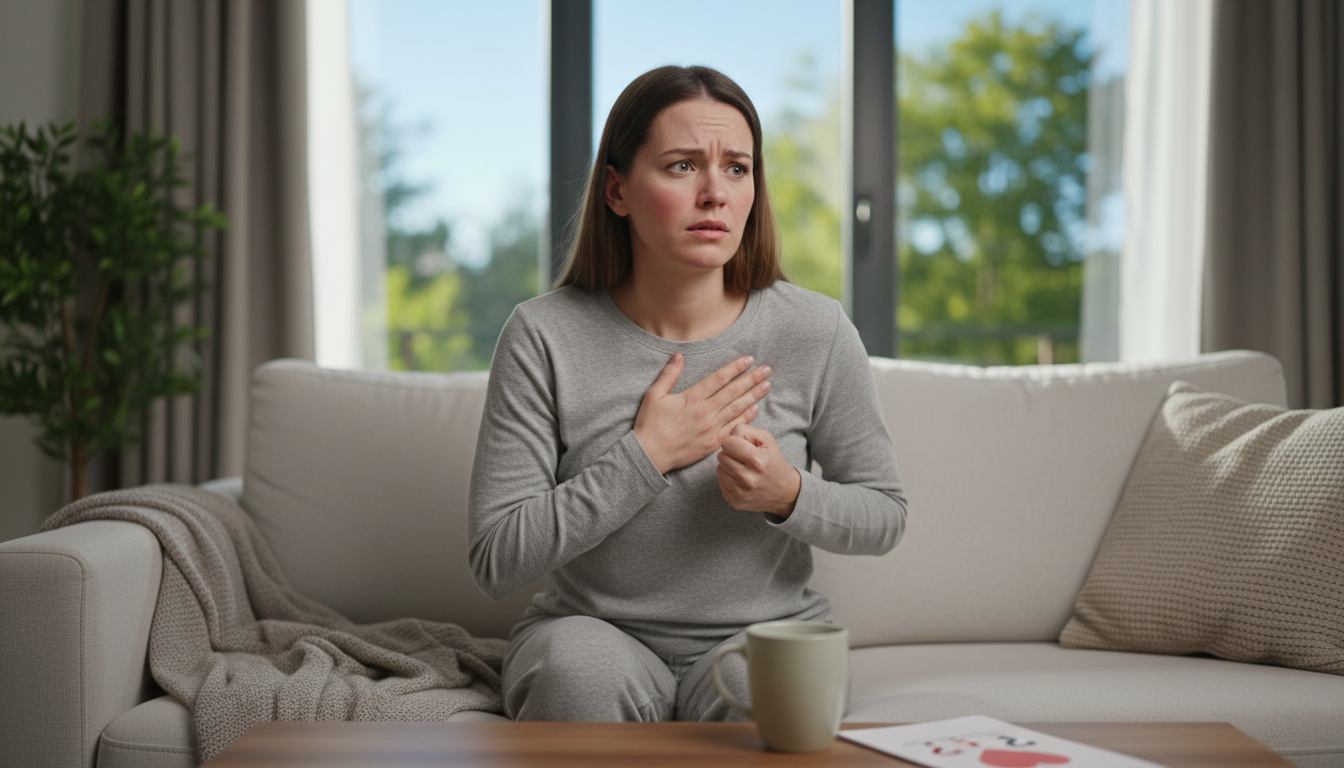
Your heart is racing, your chest feels tight, and your brain has just one question: “Is this normal… or am I in serious trouble?” Let’s walk through this calmly, step by step, without doom-scrolling or spiraling.
First: Quick Self-Check – Do You Need Emergency Care Right Now?
Before anything else, pause and check for red flag symptoms. If any of these are happening, do not keep reading – seek emergency care immediately (call 911 in the U.S.).
Call emergency services right away if:
- Chest pain or tightness is heavy, crushing, or squeezing, especially in the center or left side of the chest
- Pain spreads to your arm, shoulder, neck, jaw, or back
- You feel short of breath (like you can’t get enough air)
- You feel faint, weak, or about to pass out
- You’re sweating a lot, nauseated, or vomiting
- You have sudden confusion, trouble speaking, or one side of your face, arm, or leg feels weak or numb
- Your heart is racing or irregular and you have known heart disease, very high blood pressure, or a history of blood clots or stroke
These can be signs of a heart attack, dangerous arrhythmia, pulmonary embolism, or stroke, which are emergencies.
Takeaway: If your gut is screaming “this feels really wrong,” trust it and get help now.
Why Your Heart Might Be Racing and Your Chest Tight Right Now
A racing heart (often called palpitations) plus chest tightness can come from a wide range of causes – some benign, some urgent.
Common, Often Less Dangerous Causes
These are very common and often not life-threatening, but still worth discussing with a healthcare professional.
-
Anxiety or panic attacks
- The body’s “fight-or-flight” system turns on.
- Heart rate shoots up, breathing becomes faster or shallow, and chest muscles can tense.
- You may feel:
- Racing heart
- Chest tightness or discomfort
- Feeling of doom, unreality, or “I’m going to die”
- Tingling in hands or face, dizziness, or shaking
- Panic symptoms can peak within minutes and then slowly ease.
-
Stress and stimulants combo
- Caffeine (coffee, energy drinks, pre-workout), nicotine, certain decongestants, or some ADHD meds can make your heart beat faster.
- Add poor sleep, dehydration, or stress, and your body is primed to feel on edge.
-
Muscle or chest wall strain
- Sore or tight chest muscles (from exercise, posture, lifting, or even coughing) can feel like “tightness” or pressure.
- Often worse when you move, twist, or press on the area.
-
Acid reflux (GERD)
- Stomach acid can irritate the esophagus and mimic chest discomfort.
- Often worse after big meals, lying down, or certain foods.
-
Benign heart rhythm changes
- Some people get brief extra beats or episodes of fast but not dangerous rhythms.
- Can feel like fluttering, pounding, or a skipped beat followed by a thud.
Takeaway: There are many non-emergency reasons your heart can race and your chest can feel tight, especially if you’re anxious or stressed. But it is still important to rule out the serious causes.
When It Is Not Just Anxiety: Red Flags to Watch Over the Next Hours
Even if you’re not in immediate crisis, call a doctor or urgent care today (or as soon as possible) if:
- The chest tightness keeps coming back or lasts more than a few minutes at a time
- You notice it with activity (walking, climbing stairs) and it eases with rest
- You’ve never felt this before and it’s suddenly new and intense
- You’re pregnant, recently had surgery, have been on a long flight, or immobilized (higher risk for clots)
- You have risk factors like:
- High blood pressure
- High cholesterol
- Diabetes
- Smoking
- Strong family history of heart disease at a young age
These raise concern for heart- or lung-related causes that should be checked sooner rather than later.
Takeaway: New, unexplained, or exertion-related chest symptoms should always be checked out.
Anxiety vs Dangerous Heart Problem: How Do You Tell?
Many people worry, “What if it’s just anxiety? I don’t want to waste anyone’s time… but what if it’s not?” You can’t safely 100 percent self-diagnose this at home, but some patterns can give clues.
Things That Lean More Toward Anxiety or Panic
These are not proof, just patterns commonly seen:
- You’ve had similar episodes before that were checked and labeled as panic or anxiety
- Symptoms come on suddenly during stress, an argument, or while spiraling in your thoughts
- You feel:
- A wave of fear, dread, or “I’m going to lose control”
- Numbness or tingling in hands, feet, or around your mouth
- Shaking, trembling, or feeling detached from reality
- Your heart rate is fast but regular, and gradually settles once you:
- Slow your breathing
- Change environments
- Distract yourself or are reassured
Things That Lean More Toward a Heart or Lung Issue
Again, not a diagnosis, but clues that deserve prompt medical attention:
- Chest tightness or pain with physical activity, improving with rest
- Pain that feels heavy, squeezing, or like pressure in the center or left chest
- Shortness of breath that doesn’t match your exertion level
- Pain plus one-sided leg swelling, recent surgery, or long travel (blood clot risk)
- Palpitations plus fainting, near-fainting, or severe lightheadedness
Takeaway: If you’re unsure, err on the side of getting checked. Clinicians would much rather see you for a scare than miss a real emergency.
Real-Life Scenarios: What This Can Look Like
To make this less abstract, here are a few common real-world patterns. These are simplified examples, not diagnoses.
Scenario 1: The 2 a.m. Panic Spiral
You’re in bed scrolling your phone. Suddenly you notice your heart pounding. You focus on it and it gets faster. Your chest feels tight. You take a deep breath, it feels strange, and now you’re sure something’s wrong. You may start sweating, your hands tingle, and you think, “I’m dying.” You sit up, pace, maybe search symptoms online, feel even worse, then slowly, after 15–30 minutes of breathing, crying, or distraction, it settles.
This pattern is classic for panic attacks or high anxiety, especially if it happens repeatedly and tests such as ECG and blood work have been normal.
Scenario 2: The “Only When I Walk” Chest Tightness
You’re fine sitting on the couch, but when you walk up a hill or climb stairs, you feel tightness or pressure in your chest. If you stop and rest, it eases. When you start moving again, it comes back. That exertion-related pattern can be a sign of reduced blood flow to the heart (angina) and should be evaluated quickly.
Scenario 3: The After-Coffee Heart Race
You drink an energy drink, skip lunch, and rush through the day. Your heart feels fast and thumpy, your chest a bit tight, and you’re jittery. You also slept only a few hours the night before. In this case, stimulants, dehydration, and stress may be driving your symptoms. It’s still worth talking to a clinician, but cutting back caffeine and improving sleep often helps.
Takeaway: The pattern of when and how symptoms show up is a big clue, but it never replaces a proper medical evaluation.
What You Can Do Right Now
These steps don’t replace medical care, but can help you get through the moment and gather useful information.
1. Check Your Heart Rate and Breathing
If you have a watch, fitness tracker, or pulse oximeter, glance at it. If you have no devices, you can:
- Place two fingers gently on the side of your neck or inside your wrist.
- Count beats for 30 seconds and multiply by 2.
This number is not a diagnosis, but it’s helpful data when you talk to a clinician.
2. Slow Your Breathing on Purpose
When you’re anxious, you often over-breathe, which can worsen chest tightness and tingling. Try this simple pattern for 2–5 minutes:
- Inhale through your nose for 4 seconds
- Exhale gently through your mouth for 6 seconds
- Repeat, letting your belly rise more than your chest
If this makes symptoms much worse, stop and seek help.
3. Change Your Environment
- Sit or lie down in a comfortable position.
- Loosen tight clothing such as a bra, tie, or belt.
- If you’re somewhere stressful (argument, loud environment, heavy workload), step away if you can.
4. Reality-Check Your Thoughts
Notice if your thoughts are extreme, such as “I’m definitely going to die right now” or “If my heart races, it means heart attack.” Try to gently swap these for more balanced thoughts like “This feels scary, but a racing heart can also happen with anxiety” or “I can get checked if I’m worried – I don’t have to solve this alone.”
5. Decide on Your Next Action: Watch, Call, or Go In
Use this as a rough guide:
- Go to the ER or call 911: Severe, crushing, spreading chest pain; major shortness of breath; fainting; confusion; or sudden, intense “something is very wrong” feeling.
- Call a nurse line, urgent care, or doctor today: New or worsening symptoms, exertion-related chest tightness, or repeated unexplained episodes.
- Schedule a routine visit: Mild, brief symptoms that seem clearly linked to anxiety, caffeine, or stress, but you want a professional opinion.
Takeaway: You don’t have to decide “it’s fine” or “it’s fatal” alone. Use professionals – that’s what they’re there for.
Tests a Doctor Might Use
If you go in to be evaluated, here’s what might happen:
- History and physical exam – Questions about when it started, triggers, exact sensations, medical history, medications, and family history.
- Vital signs – Heart rate, blood pressure, oxygen level, temperature.
- ECG/EKG – A quick, painless test to look at your heart’s rhythm and electrical activity.
- Blood tests – To check for heart damage markers, anemia, thyroid issues, electrolytes, and more, depending on the situation.
- Chest X-ray – To look at lungs, heart size, and chest structures.
- Sometimes an echocardiogram, stress test, or heart monitor over days or weeks if needed.
For anxiety or panic, your provider may also:
- Screen for anxiety disorders, depression, or trauma history
- Talk about therapy, lifestyle changes, and possibly medication
Takeaway: Getting checked doesn’t mean something terrible will be found. Often, it is the path to reassurance and a clear plan.
How to Reduce Future Episodes of Heart Racing and Chest Tightness
Whether your main issue ends up being anxiety, lifestyle, or a medical condition, there are habits that generally help your heart and nervous system.
1. Tame the Stimulants
- Cut back on caffeine (coffee, tea, soda, energy drinks, pre-workout powders).
- Avoid nicotine and recreational stimulants.
- Be cautious with decongestants that contain pseudoephedrine or similar ingredients – they can speed up your heart.
2. Support the Basics
- Aim for consistent sleep (7–9 hours for most adults).
- Stay hydrated; even mild dehydration can make your heart beat faster.
- Eat regular, balanced meals to avoid blood sugar crashes.
3. Train Your Nervous System to Calm Down
- Practice slow breathing or relaxation daily, not just during crises.
- Try walking, yoga, or gentle exercise, which can reduce resting anxiety and improve heart health.
- Consider therapy, especially cognitive behavioral therapy (CBT), if anxiety or panic is frequent.
4. Follow Up on Medical Advice
If a clinician suggests cardiology follow-up, anxiety treatment (therapy or medication), a sleep study, or medication changes, try to follow through on those referrals.
Takeaway: Long-term change is gradual but powerful, and your heart tends to reward consistency.
So… Is What You’re Feeling Right Now “Normal”?
Racing heart and chest tightness are common symptoms, and they often show up with anxiety, panic, stress, or stimulants. They can also be signs of serious problems, especially when paired with red-flag symptoms such as crushing pain, trouble breathing, fainting, spreading pain, or confusion. You can’t safely self-diagnose this at home, and you never have to feel silly for getting checked.
If you’re unsure what to do, try this:
- Re-scan the emergency red flags at the top.
- If any apply, stop reading and seek help now.
- If they don’t, but you’re still scared, call a nurse line, urgent care, or your doctor and describe exactly what you’re feeling.
You are not overreacting by taking your symptoms seriously.
Sources
- Mayo Clinic – Chest pain: First aid and causes (symptoms, red flags, when to seek care) – https://www.mayoclinic.org/symptoms/chest-pain/basics/when-to-see-doctor/sym-20050838
- American Heart Association – Warning signs of a heart attack (emergency symptoms, patterns) – https://www.heart.org/en/health-topics/heart-attack/warning-signs-of-a-heart-attack
- Cleveland Clinic – Heart palpitations: Causes, symptoms & treatment (palpitations and anxiety, stimulants) – https://my.clevelandclinic.org/health/diseases/17057-heart-palpitations
- MedlinePlus (U.S. National Library of Medicine) – Panic disorder (panic attack symptoms and causes) – https://medlineplus.gov/panicdisorder.html
- Mayo Clinic – Anxiety disorders (physical symptoms of anxiety) – https://www.mayoclinic.org/diseases-conditions/anxiety/symptoms-causes/syc-20350961
- Cleveland Clinic – Angina (chest pain) (exertional chest tightness and heart disease) – https://my.clevelandclinic.org/health/symptoms/16874-angina
- CDC – Basics about blood clots (pulmonary embolism risk factors and symptoms) – https://www.cdc.gov/ncbddd/dvt/facts.html
Leave a Reply