Anxiety Or Heart Problem? How To Tell What Your Body’s Really Saying
You’re sitting there, minding your own business, when suddenly:
- Your heart starts pounding.
- Your chest feels weird.
- You’re lightheaded, maybe a little shaky.
Cue the mental spiral: “Is this anxiety… or am I having a heart attack?”
If that sounds familiar, you’re not alone. Many people end up in the ER multiple times convinced something is wrong with their heart, only to be told: “It’s anxiety.” And yet… what if this time it isn’t?
Let’s walk through this calmly and clearly. We’ll cover:
- How anxiety affects your heart and chest
- How heart problems can show up
- Key differences and overlap
- Red-flag symptoms that mean get help now
- When it’s likely anxiety—and what to do about it
This is education, not diagnosis. If you’re in doubt about your symptoms, especially new or severe ones, it’s always safer to get checked.
How Anxiety Can Feel Like a Heart Problem
When you’re anxious or having a panic attack, your body flips into fight-or-flight mode:
- Adrenaline surges
- Heart rate goes up
- Breathing gets faster and shallower
- Muscles tense
That can create a cluster of symptoms that look terrifyingly “cardiac”:
- Pounding, racing, or skipping heartbeats (palpitations)
- Chest tightness, pressure, or sharp pains
- Shortness of breath or “can’t get a full breath” feeling
- Sweaty, shaky, tingling hands, feet, or face
- Dizziness, feeling like you’ll faint
Classic Anxiety or Panic “Heart” Scenario
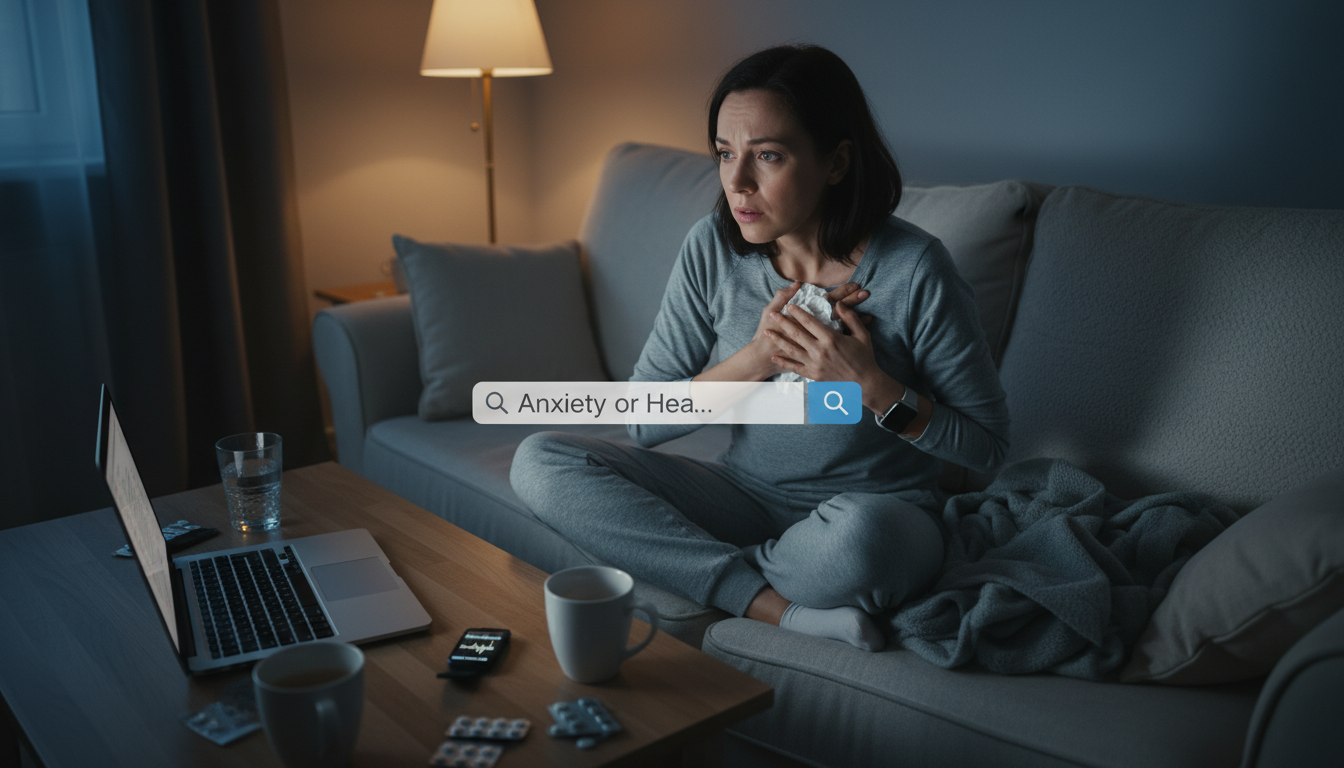
You’re stressed or worried (sometimes about your health), scrolling on your phone, maybe you notice your heart beating. You focus on it. The more you notice, the faster it feels. Now your chest feels tight. You Google symptoms and panic skyrockets.
Ten to twenty minutes later, the intense wave often peaks and then starts to fade, even if you feel wrung out afterward.
Takeaway: Anxiety can produce very real physical sensations that mimic heart problems. The fear of heart trouble can also fuel more anxiety, creating a loop.
How Heart Problems Can Show Up
Heart problems range from mild and manageable to life-threatening emergencies. Not every heart issue looks like a movie heart attack, and not every heart symptom is dramatic.
Common heart-related symptoms can include:
- Chest discomfort (pressure, fullness, squeezing, or pain)
- Pain that may spread to the arm, jaw, neck, back, or upper stomach
- Shortness of breath (especially with exertion)
- Unexplained fatigue
- Nausea, sweating, or lightheadedness
- Irregular, very fast, or very slow heartbeat
Some people—especially women, older adults, and people with diabetes—may have less typical symptoms, like fatigue, indigestion-like discomfort, or mild chest pressure instead of sharp pain.
Takeaway: Heart issues aren’t always dramatic, and they don’t always feel like “pain.” They can be subtle, especially early.
Anxiety vs Heart Problem: What’s the Difference?
There is overlap, and that’s exactly why it’s confusing. But there are some patterns that can help you think it through while you decide whether to seek care.
1. How Did It Start?
- Anxiety or panic
- Often starts suddenly during a stressful moment, argument, worry spiral, or for “no clear reason” while already feeling on edge.
- You might notice a thought first: “Something’s wrong with me” → then your body ramps up.
- Heart problem
- Can start with physical exertion (walking upstairs, shoveling snow, exercising) or emotional stress—but can also occur at rest.
- May build gradually (tightness or pressure that keeps getting worse) instead of exploding into full panic quickly.
2. What Does the Chest Discomfort Feel Like?
- More suggestive of anxiety:
- Sharp, stabbing, fleeting pains.
- Random zaps or pinpricks around the chest that move or change with position.
- Tightness that improves when you distract yourself, breathe slowly, or change positions.
- More concerning for heart issues (especially with risk factors):
- Pressure, squeezing, heaviness, or band-like tightness in the center or left side of the chest.
- Discomfort that may spread to the arm, jaw, neck, or back.
- Pain or pressure that worsens with exertion and improves with rest.
3. How Long Does It Last and What Helps?
- Anxiety or panic
- Intense peaks often last 10–20 minutes (though some symptoms or “aftershocks” can linger longer).
- May come in waves, linked to worry, panic, or specific triggers.
- Often improves with:
- Reassurance
- Deep, slow breathing
- Grounding or distraction
- Leaving the stressful situation
- Heart problem
- Discomfort may last more than a few minutes, sometimes coming and going but not fully settling.
- Often triggered or worsened by physical effort—walking, climbing, carrying groceries—and eases when you rest.
- Doesn’t reliably go away with calming techniques alone.
4. What Else Is Happening in Your Body?
- Anxiety often brings:
- Sense of dread or “I’m about to die” feeling
- Fast breathing, sometimes tingling around the mouth or in fingers
- Shakiness, restlessness, feeling wired
- GI symptoms (nausea, urgent need to use the bathroom)
- Heart issues can bring:
- Shortness of breath out of proportion to activity
- New swelling in legs, ankles, or feet
- Unusual fatigue, especially with simple tasks
- Feeling like your heart is flip-flopping, racing, or pausing in a way that doesn’t match your activity level
Important: Anxiety and heart problems can coexist. Having anxiety doesn’t mean your heart is fine, and having a heart condition doesn’t mean you can’t also get panic attacks.
Takeaway: Patterns matter—triggers, type of pain, duration, and what makes it better or worse all give clues—but none of this replaces medical evaluation.
Fast Check: When It’s Probably Anxiety
These features lean more toward anxiety or panic, especially if you’ve been checked by a doctor before and had normal tests:
- You’ve had similar episodes in the past that were diagnosed as panic or anxiety.
- Symptoms hit during stress, worry, or after focusing on your body.
- Heart tests you’ve had (like EKG, blood work, maybe an echocardiogram or Holter monitor) have been reassuring.
- The intense phase passes within about 20–30 minutes, even if you still feel “off” afterward.
- Symptoms clearly improve with:
- Slow breathing
- Walking around a bit
- Talking to someone you trust
- Distraction (music, TV, call, grounding exercises)
If that sounds like you, working on anxiety management can make a dramatic difference:
- Cognitive behavioral therapy (CBT)
- Breathing and relaxation techniques
- Exercise (as cleared by your doctor)
- Reducing stimulants like caffeine and nicotine
Takeaway: If your heart’s been medically cleared and your episodes match the anxiety pattern, focusing on anxiety treatment is not “missing something”—it’s addressing the real issue.
Emergency Red Flags: Don’t Second-Guess These
If you experience any of the following, don’t sit at home trying to logic your way through whether it’s anxiety or a heart problem. Get emergency help immediately (in the U.S., call 911):
- Chest pain, pressure, or tightness that:
- Lasts more than a few minutes
- Is severe
- Comes with a feeling of crushing or squeezing
- Pain or discomfort spreading to your arm, jaw, neck, back, or upper stomach
- Trouble breathing or shortness of breath, especially at rest or with light activity
- Sudden, severe weakness, fainting, or feeling like you will pass out
- Sudden confusion, trouble speaking, severe headache, or difficulty seeing
- Fast, irregular, or very slow heartbeat accompanied by dizziness, chest discomfort, or fainting
- New chest pain if you already have heart disease, high blood pressure, diabetes, high cholesterol, or you smoke
When in doubt, err on the side of going in. Medical teams expect false alarms; what they don’t want is someone staying home with a real emergency.
Takeaway: If you’re asking, “Is this bad enough to go in?” and your gut is screaming “maybe,” it’s safer to be checked.
Grey Zone: When You’re Not Sure
Sometimes symptoms are confusing. Not clearly panic, not obviously cardiac. Here’s how to think about next steps.
Ask Yourself a Few Questions
- Is this new or very different from your usual anxiety?
- New pattern = lower threshold to see a doctor.
- Do you have heart risk factors?
- Smoking, high blood pressure, high cholesterol, diabetes, obesity, strong family history of early heart disease.
- The more risk factors, the less you should assume “it’s just anxiety.”
- Has a doctor recently checked your heart?
- If you’ve never had it checked, or it’s been years, book an appointment—even if your symptoms settle.
- How often is this happening?
- Recurrent episodes (even if they turn out to be panic) deserve proper evaluation and treatment. You shouldn’t have to live in constant fear.
Good “Middle Path” Options
- Urgent care or same-day clinic if:
- Symptoms are worrying but not severe or emergency-level.
- You want an EKG or vital signs checked for peace of mind.
- Primary care or cardiology follow-up if:
- You’ve had multiple episodes.
- You want to understand your heart health and risk.
Takeaway: You don’t have to choose between “ignore it” and “full-blown ER visit” every time. There are intermediate options.
What You Can Do in the Moment (While You Seek Help If Needed)
If you’ve decided your symptoms are not emergency-level but feel very scary, here are steps that can help both anxiety and some benign heart sensations like palpitations:
- Check your surroundings for safety.
- If you’re driving, pull over.
- Sit or lie down if you feel faint.
- Slow your breathing. Try this:
- Inhale through your nose for 4 seconds.
- Hold for 2 seconds.
- Exhale slowly through your mouth for 6 seconds.
- Repeat for a few minutes.
- Ground your senses.
- Name 5 things you can see, 4 you can feel, 3 you can hear, 2 you can smell, 1 you can taste.
- This pulls attention out of the fear spiral and back into your body and environment.
- Notice, don’t battle.
- Instead of “This must stop now or I’ll die,” try: “My nervous system is in overdrive. These sensations are intense but not automatically dangerous.”
- Decide on your next step.
- If symptoms worsen, new red flags show up, or you’re still unsure—seek urgent or emergency care.
- If things settle and you’ve already been evaluated in the past, plan a follow-up with your doctor to talk about anxiety and/or heart testing if needed.
Takeaway: Calming your nervous system is useful either way—for anxiety and for your heart. It doesn’t replace medical care, but it can dial down the panic.
Long-Term Plan: Protect Both Your Heart and Your Mind
You don’t have to choose between “heart care” and “anxiety care.” In reality, supporting one helps the other.
For Your Heart
- Work with your doctor on:
- Blood pressure
- Cholesterol
- Blood sugar
- Weight management
- Move regularly (as medically cleared)—even walking counts.
- Don’t smoke; if you do, ask about quit-support options.
For Your Anxiety
- Ask about therapy, especially CBT or other evidence-based approaches.
- Consider whether medication could help (discuss risks and benefits with your provider).
- Build a toolkit: breathing practices, grounding, journaling, relaxation apps, routines.
- Reduce triggers where possible:
- Too much caffeine
- Doom-scrolling symptoms
- Chronic sleep deprivation
Takeaway: The goal isn’t to never feel your heart beat fast again. It’s to know when it’s likely anxiety, when it might be a heart problem, and to feel equipped—not helpless.
The Bottom Line
If you’re torn between “anxiety or heart problem,” remember:
- Anxiety can cause very real chest symptoms and palpitations.
- Heart problems can be subtle—and they matter.
- Patterns (triggers, type of pain, duration, response to rest or calming) give clues, but they are not a diagnosis.
- Red-flag symptoms or strong gut concern = get checked, immediately if severe.
- After serious causes are ruled out, treating anxiety is not “giving up”—it’s taking your symptoms seriously in the right way.
You deserve both reassurance and good medical care. If this question lives rent-free in your brain, let that be your nudge to book a proper checkup—and maybe also a conversation about anxiety. You don’t have to figure it out alone.
Leave a Reply