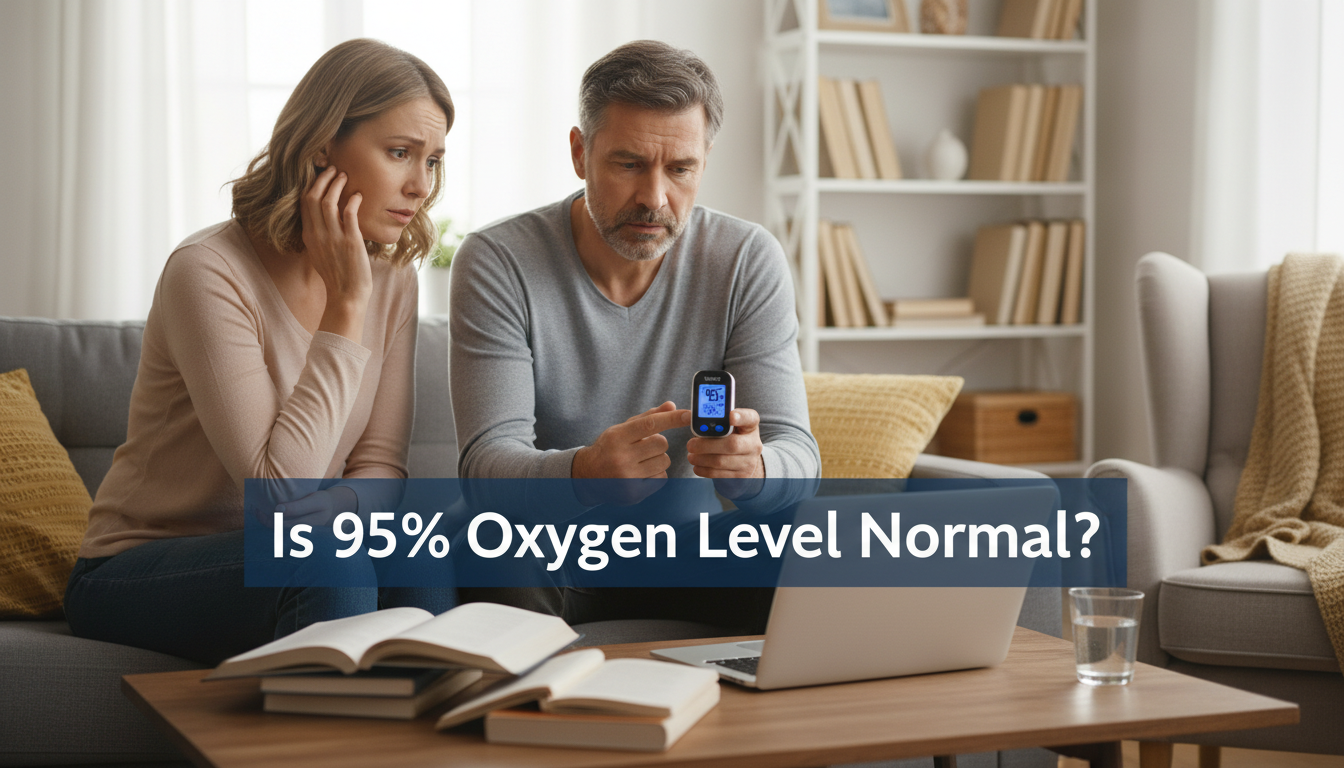
Is Oxygen Level 95 Normal?
Disclaimer: This article is for general information only and isn’t medical advice or a diagnosis. If you have severe symptoms or think it may be an emergency, call your local emergency number.
You glance at your pulse oximeter. Ninety-four, ninety-five, ninety-six, back to ninety-five. Cue mild panic: “Wait… is an oxygen level of 95 normal or am I supposed to freak out now?”
Let’s slow that mental spiral down. In this post, we’ll break down what a 95% oxygen level usually means, when it’s okay, when it’s a yellow flag, and when it’s a “stop reading and seek care now” situation.
Quick Answer: Is Oxygen Level 95 Normal?
Short version: For many people, an oxygen saturation (SpO₂) of 95% is within the low end of the normal range, especially if:
- You’re otherwise feeling okay (no severe shortness of breath, chest pain, confusion, or blue lips/face).
- The reading is stable (not suddenly dropping into the 80s or low 90s).
- You just took it at home on a small finger device that can be a bit off.
In general, normal SpO₂ in healthy adults is often quoted as 95–100%. Many guidelines start to call it “low” or “concerning” when it’s consistently under 94%, especially if you feel unwell.
Key takeaway: A single reading of 95% in a person who feels fine is usually not an emergency. But context really matters.
What Does Oxygen Level (SpO₂) Actually Measure?
Your pulse oximeter (the little finger clip or smartwatch sensor) is estimating your peripheral oxygen saturation—essentially, what percentage of your red blood cells’ hemoglobin is carrying oxygen.
- 100% means basically all the hemoglobin it’s seeing is carrying oxygen.
- 95% means most hemoglobin is carrying oxygen, but there’s a small drop from the top.
Because of how the oxygen–hemoglobin curve works, the difference between 97% and 95% is usually not a dramatic change in actual oxygen content in your blood. The curve is flat at the top, so small number changes there don’t always equal big changes in how your body functions.
Takeaway: SpO₂ is a useful clue, not a perfect window into your health.
What Is Considered a Normal Oxygen Level?
Different organizations and hospitals use slightly different cutoffs, but many clinicians roughly use these ranges for adults at sea level:
- 95–100%: Generally considered normal for most healthy adults.
- 93–94%: Slightly low, may be okay for some people (for example, mild lung disease, high altitude), but worth monitoring.
- 90–92%: Low—often a reason to contact a clinician promptly, especially if new.
- Below 90%: Often called hypoxemia (low blood oxygen) and usually needs urgent medical evaluation.
So where does your 95% fit? Right at the lower edge of “normal” for many people.
Takeaway: On most charts, 95% is still wearing the “normal” badge, just not the honor-roll version of normal.
When Is 95% Oxygen Level Usually Okay?
A reading of 95% is more reassuring when:
-
You feel well overall
- No severe shortness of breath
- No chest pain or chest tightness
- No confusion, extreme fatigue, or new dizziness
-
The number is stable
- It stays around 94–97% across several checks.
- It doesn’t suddenly drop 4–5 points when you stand or walk.
-
You’re at mild altitude
Higher elevation (mountains, some cities) can lower normal SpO₂ a bit.
- You have a known lung or heart condition and your care team has told you that mid-90s is your usual baseline.
-
The device isn’t perfect
Pulse oximeters, especially cheap home ones or fitness wearables, can be off by 2–3 percentage points under real-world conditions. That means your “95%” could realistically be 93–98%.
Takeaway: If you feel fine and keep seeing around 95% without other red-flag symptoms, it’s usually not a reason to panic, but it can be a good reason to keep an eye on the trend.
When Might 95% Oxygen Be a Yellow Flag?
A 95% oxygen level deserves extra attention in some situations.
1. It’s New for You
Example scenarios:
- You normally see 98–99%, but today you’re hanging around 94–95% and you feel more winded than usual.
- You recently had a respiratory infection (COVID, flu, pneumonia, RSV, bronchitis), and now your numbers are lower than your normal.
In these cases, 95% isn’t automatically dangerous, but the change from your baseline matters.
2. It Drops With Light Activity
If your oxygen level is 95% at rest, but:
- Falls to 90–92% after walking across the room, or
- Takes a long time to come back up after mild activity,
that’s more concerning and worth checking with a clinician.
3. You Have Risk Factors
Use extra caution if you have:
- Chronic lung disease (COPD, severe asthma, pulmonary fibrosis)
- Heart failure or other significant heart conditions
- Sleep apnea or obesity hypoventilation
- Recent surgery, especially chest or abdominal
In these settings, even low-normal numbers can carry more weight and may be part of a bigger picture your doctor needs to know about.
Takeaway: 95% isn’t an automatic crisis, but if it’s new, dropping, or paired with risk factors, treat it as a reason to check in with a professional.
When Is a 95 Oxygen Level Not Okay? Red Flags to Watch For
Numbers are only half the story. Symptoms plus numbers together tell you much more.
Regardless of the exact number, seek urgent or emergency care (call your emergency number or go to an emergency department or urgent care) if you have:
- Shortness of breath at rest or struggling to speak in full sentences
- Chest pain, pressure, or discomfort
- Bluish lips, face, or fingernails
- Severe confusion, difficulty staying awake, or sudden change in mental state
- Oxygen level dropping below about 90–92%, especially if it stays there
- Rapid breathing and feeling like you cannot catch your breath
In these scenarios, 95% at one moment doesn’t rule out a serious problem. Your oxygen could be fluctuating, or the device could be missing what your body is clearly telling you.
Takeaway: If your body is clearly telling you something is wrong, trust that over a single number.
How Reliable Is a Home Pulse Oximeter Reading of 95?
Home pulse oximeters and smartwatches are helpful, but they are not perfect diagnostic tools.
Things that can make a reading of 95% less accurate include:
- Cold fingers (poor circulation lowers signal quality)
- Movement (shaking, talking, walking during the reading)
- Nail polish or artificial nails (especially dark colors)
- Skin tone (some devices may be less accurate in people with darker skin tones)
- Poorly fitting device or cheap, unvalidated models
Ways to improve accuracy:
- Sit still for a few minutes.
- Warm your hands (rub them, use warm water, or hold a mug).
- Remove dark nail polish or try a different finger.
- Hold your hand at heart level and keep still while it reads.
- Take several readings over a few minutes rather than believing the very first number.
Takeaway: A 95% reading from a home device has some wiggle room. Always pair it with how you actually feel.
Case Studies: When 95% Means Different Things
Case 1: The Mildly Anxious but Healthy Person
Alex is a healthy 28-year-old with no lung or heart issues. They buy a pulse oximeter during cold season just to check. It reads:
- Resting: 95–98%
- Walking around the house: briefly 94–95%, then back to 96–98%
Alex feels fine, no shortness of breath, just general anxiety.
Likely interpretation: This is within normal variation. The 95% readings alone, in someone who feels well, are not concerning.
Case 2: The Post-COVID Patient
Jordan is 52 and recently had COVID with a bad cough and fatigue. A week later:
- Resting SpO₂: 94–95%
- Walking across the room: drops to 91–92%, takes a minute to come back up
- Still feels more short of breath than usual
Likely interpretation: This pattern is more concerning. Even though 95% appears, the drops with movement, the recent infection, and ongoing shortness of breath make this something to discuss with a clinician promptly.
Case 3: The Person With Known COPD
Maria is 67 with COPD. Her doctor has told her:
- Her usual baseline at rest is 92–94%.
- She should seek help if she’s under 88–89% or much more short of breath.
One day, Maria checks and sees 95% at rest.
Likely interpretation: For Maria, 95% is actually better than her usual baseline and can be reassuring, as long as symptoms aren’t worse.
Takeaway: The same number (95%) can be normal, low-normal, or even better than usual, depending on the person.
What Should You Do If Your Oxygen Level Is 95?
Here’s a simple decision framework you can use at home.
Step 1: Check How You Feel
Ask yourself:
- Am I having trouble breathing at rest or speaking?
- Do I have chest pain, blue lips, or feel like I might pass out?
- Do I feel confused, extremely drowsy, or “not right” mentally?
If the answer is yes to any of these, seek urgent or emergency care, regardless of what the number says.
Step 2: Repeat the Measurement Correctly
If you feel basically okay but you’re worried about the 95%:
- Rest for 5–10 minutes.
- Make sure your hands are warm and still.
- Check on a different finger.
- Take two to three readings over 5 minutes.
Pay attention to:
- Trend: Staying 94–96% versus dropping into the 80s or low 90s
- Symptoms: Any change when walking, talking, or lying flat
Step 3: Contact a Clinician If…
You should call your doctor, a nurse line, or telehealth if:
- Your SpO₂ is consistently 93–94% or lower, even at rest, especially if this is new for you.
- You recently had a respiratory infection and your numbers are lower than before.
- You have lung or heart disease and your readings are down from your known baseline.
- You feel more short of breath than usual, even if the number is 95–96%.
Takeaway: 95% is often okay, but your symptoms and their changes over time are just as important.
Key Points to Remember About a 95 Oxygen Level
To summarize:
- Is 95 oxygen level normal? For many adults at sea level, yes—95% is at the low end of normal, especially if you feel well.
- Context is everything. A single 95% reading means little without symptoms, trends, and your own baseline.
- Red flags beat numbers. Severe shortness of breath, chest pain, confusion, blue lips or face, or readings under about 90–92% are reasons to seek urgent care.
- Devices have limits. Home pulse oximeters can be off by a few points and don’t replace clinical judgment.
- When in doubt, call. If your oxygen numbers worry you or you feel worse than usual, reach out to a healthcare professional rather than just watching the digits change.
Your job is to use your pulse oximeter as a tool, not a fortune-teller. Listen to your body, watch the trends, and get help when your symptoms or your instincts say something isn’t right.
Sources
- Mayo Clinic – “Pulse oximeter: How it works, what it measures” (how pulse oximeters work, normal ranges)
https://www.mayoclinic.org/tests-procedures/pulse-oximetry/about/pac-20385075 - Cleveland Clinic – “Blood Oxygen Level: What It Is & What It Affects” (normal vs low oxygen levels, symptoms)
https://my.clevelandclinic.org/health/diagnostics/22447-blood-oxygen-level - MedlinePlus (U.S. National Library of Medicine) – “Oxygen Saturation” (definitions, ranges, hypoxemia)
https://medlineplus.gov/ency/article/007259.htm - CDC – “Clinical Guidance for COVID-19” (use of pulse oximetry, when low oxygen is concerning)
https://www.cdc.gov/coronavirus/2019-ncov/hcp/clinical-care.html - American Lung Association – “Monitoring Your Oxygen Levels” (home monitoring, when to call your doctor)
https://www.lung.org/blog/monitoring-oxygen-levels - Johns Hopkins Medicine – “Hypoxemia” (causes, symptoms, when to seek care)
https://www.hopkinsmedicine.org/health/conditions-and-diseases/hypoxemia
Leave a Reply