Chest Pressure and Normal Stress Response
Disclaimer: This article is for general information only and isn’t medical advice or a diagnosis. If you have severe symptoms or think it may be an emergency, call your local emergency number.
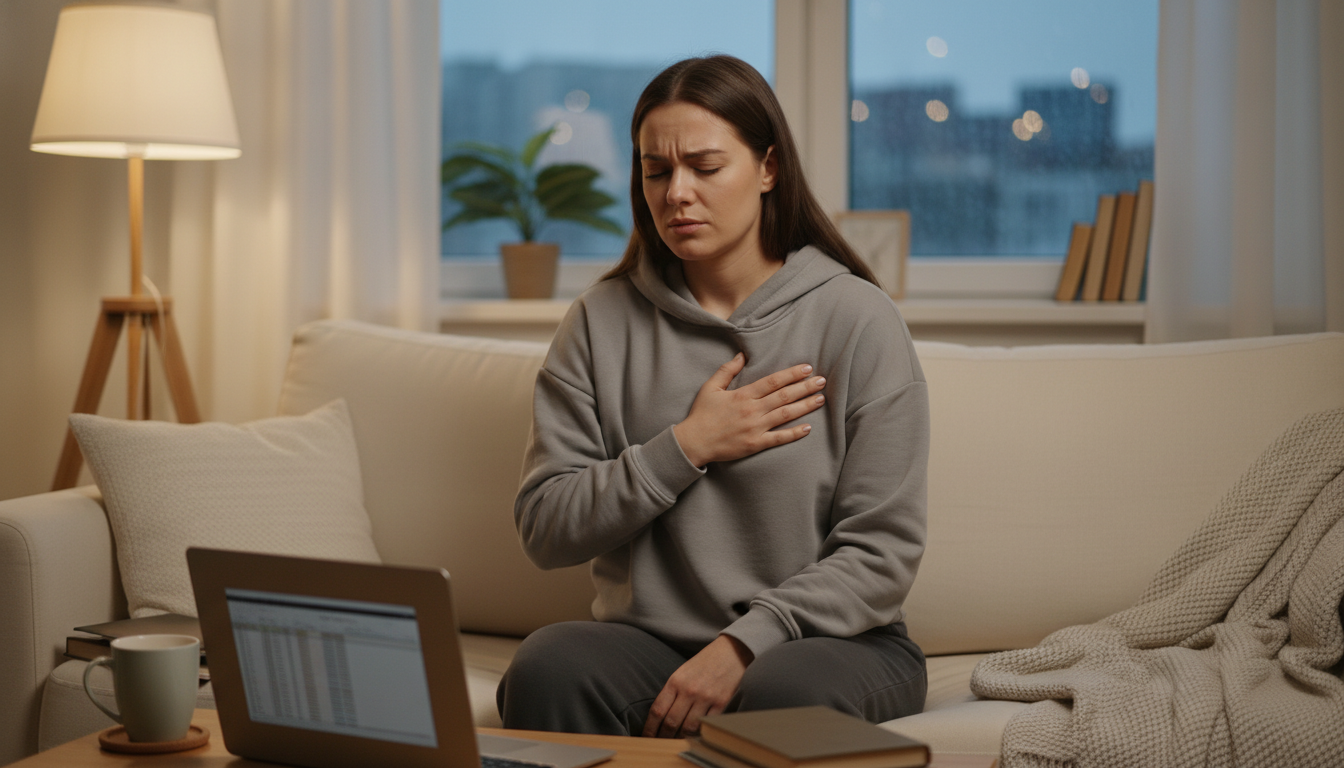
You’re sitting there, minding your own business, when suddenly: chest pressure.
If you’re feeling chest pressure right now and wondering whether it could be a normal stress response or something dangerous, you’re in the right place.
We’ll walk through:
- How stress and anxiety can cause chest pressure
- What those sensations usually feel like
- Simple ways to calm your nervous system in the moment
- When chest pressure is not just stress and needs urgent care
Can Stress Really Cause Chest Pressure?
Yes. Psychological stress and anxiety can absolutely cause real, physical chest pressure.
When you’re stressed, your body flips into fight-or-flight mode:
- Stress hormones (like adrenaline and cortisol) surge
- Heart rate and blood pressure can rise
- Breathing often becomes fast or shallow
- Muscles tighten, especially in the neck, shoulders, and chest
All of that can produce sensations like:
- A band of tightness across the chest
- Dull chest pressure, sometimes more on one side
- Achy or sore chest muscles
- Feeling like you can’t get a satisfying deep breath
Medical organizations like the American Heart Association and major clinics note that anxiety and panic attacks can mimic heart symptoms, including chest discomfort, palpitations, and shortness of breath. The symptoms are real; they’re just driven by your nervous system rather than a blocked artery.
Takeaway: Stress doesn’t just live in your head—it shows up in your chest, too.
What Does Stress-Related Chest Pressure Feel Like?
Everyone’s different, but there are some common patterns when chest pressure is mostly a stress response.
People often describe it as:
- “A tight band around my chest”
- “Like someone is lightly sitting on my chest, not stabbing it”
- “Heavy or tight, especially when I’m anxious or overthinking”
- “Worse when I’m paying attention to it, better when I’m distracted”
You might also notice:
- It comes on during or after a stressful situation or argument
- It shows up alongside other anxiety symptoms: racing thoughts, sweating, trembling, feeling unreal or detached, upset stomach, fear something terrible is about to happen
- It may ease when you:
- Lie down and relax
- Breathe slowly and deeply
- Get your mind absorbed in something else
Two Quick Scenarios
Scenario 1: The Email from Your Boss
You open a tense email. Ten minutes later, your chest feels tight and your shoulders are near your ears. Your thoughts are spiraling, your breathing is shallow. You walk outside, take slow breaths, and scroll less. After 15–20 minutes, the pressure eases.
Scenario 2: The 3 a.m. Google Spiral
You’re in bed, worrying about money, health, or family. Chest pressure shows up, plus a racing heart. You sit up, panic a little, maybe Google symptoms, which does not help. Eventually, once you slow your breathing and distract yourself, it fades.
Takeaway: If chest pressure tracks closely with stress spikes and improves with calming strategies, that points more toward a normal stress response.
What’s Happening in My Body During Stress Chest Pressure?
Let’s break down the biology in plain English.
1. Muscle Tension
Stress makes your muscles brace, like you’re preparing to get hit. Common spots include:
- Chest wall muscles
- Neck and shoulders
- Upper back
When those muscles stay tight for a while, they can feel:
- Sore
- Heavy
- Pressured
Sometimes, just pressing on a tight chest muscle can reproduce the feeling.
2. Breathing Changes
Under stress, we often start over-breathing (hyperventilating) or breathing shallowly from the upper chest.
This can:
- Make your chest feel tight or restricted
- Cause lightheadedness, tingling in hands or lips
- Make you feel like you just can’t quite get enough air
Ironically, over-breathing can create the sensation of shortness of breath, even when your oxygen level is fine.
3. Heart and Autonomic Nervous System
Your autonomic nervous system runs the fight-or-flight response.
During stress:
- Heart rate may increase
- You may feel skipped beats or pounding (palpitations)
- Blood vessels tighten slightly
All of this can create a vague, uncomfortable chest sensation, even when the heart itself is structurally healthy.
Takeaway: Stress chest pressure is usually a mix of tight muscles, fast or shallow breathing, and a revved-up nervous system.
Is My Chest Pressure Just Anxiety, or Something Serious?
This is the question that often makes people panic.
Here’s the nuance:
- Yes, anxiety can absolutely cause chest pressure.
- But chest pain or pressure can also be a sign of a heart, lung, or other medical problem.
No article on the internet can look at your specific situation, medical history, and risks. So the rule is:
If you are unsure whether your chest symptoms are serious, it is always safer to get checked.
That said, certain patterns are more typical of stress or anxiety vs. medical emergencies.
Features More Suggestive of Stress or Anxiety
These are not perfect, but they lean toward a benign, stress-related pattern:
- Started during an argument, panic, or intense worry
- Comes in waves with anxiety and eases when you calm down
- More of a dull pressure, ache, or band-like tightness
- Changes when you move, twist, or press on the area
- You’ve had something very similar evaluated by a clinician before and told it’s non-cardiac
Red-Flag Signs: Get Urgent Help
Call emergency services or go to the ER right away if chest pressure is:
- Crushing, heavy, or feels like strong pressure in the center or left side of your chest
- Lasting more than a few minutes, or goes away and comes back
- Accompanied by:
- Shortness of breath that’s getting worse
- Pain spreading to your arm, jaw, back, or neck
- Swetting, nausea, or vomiting
- Feeling faint, weak, or like you might pass out
- Happening during physical exertion (climbing stairs, walking uphill) and reliably triggered by activity
- Present along with risk factors like known heart disease, very high blood pressure, diabetes, high cholesterol, or smoking
Medical organizations emphasize: don’t try to self-diagnose a heart attack vs. anxiety at home. If it might be your heart, you want professionals, not guesswork.
Takeaway: Stress chest pressure is common, but chest symptoms can be serious. When in doubt, get checked.
What to Do Right Now If You Think It’s Stress-Related
If you’ve already been medically evaluated and told your chest symptoms are from stress or anxiety, or you’re between appointments and looking for short-term tools, here are grounding steps that often help.
These are not a substitute for emergency care. If your symptoms match the red flags above, skip this and seek urgent help.
1. Reset Your Breathing (2–3 Minutes)
Try this simple pattern:
- Breathe in through your nose for 4 seconds.
- Hold gently for 2 seconds.
- Breathe out through pursed lips (like blowing out a candle) for 6–8 seconds.
- Repeat for 10–15 breaths.
This can:
- Reduce hyperventilation
- Relax your chest muscles
- Calm your nervous system
2. Unclench Your Muscles
Do a micro body scan:
- Drop your shoulders away from your ears
- Wiggle your jaw and let your tongue rest on the floor of your mouth
- Gently roll your shoulders
- Place a hand on your chest and notice if you’re tensing there, then consciously soften the area
Sometimes the pressure eases a bit just from letting muscles relax.
3. Ground Your Mind in the Present
Your brain may be racing ahead to worst-case scenarios. Try:
- 5–4–3–2–1 grounding:
- 5 things you can see
- 4 you can touch
- 3 you can hear
- 2 you can smell
- 1 you can taste
- Or pick one neutral task such as folding laundry, a simple puzzle, or a light TV show. The goal isn’t to ignore your body, but to stop feeding the fear loop.
4. Change Your Position and Environment
Sometimes tiny changes help:
- Sit more upright if you were slumped
- Step outside or to a different room
- Loosen tight clothing around your chest or stomach
If the pressure eases as you move, stretch, and breathe, that’s more consistent with a tension or breathing pattern.
Takeaway: You can’t instantly delete stress, but you can dial down your body’s emergency sirens.
Longer-Term: Reducing Stress Chest Pressure Over Time
If this isn’t the first time you’ve searched for chest pressure information, your body might be telling you something:
Hey, we are running in stress mode way too often.
Some longer-term strategies that research supports include the following.
1. Cognitive Behavioral Therapy (CBT) or Other Therapy
Therapists who work with anxiety can help you:
- Reframe catastrophic thoughts about body sensations
- Break the cycle of “feel symptom → panic → worse symptom”
- Learn coping tools you can actually use in the moment
Many people with health anxiety or panic disorder find that therapy can dramatically reduce chest symptoms over time.
2. Regular Movement
You don’t need intense workouts to help your chest. Even:
- Brisk walking
- Gentle yoga or stretching
- Light strength training
can lower your baseline stress level and help regulate breathing.
Always clear new exercise plans with a clinician if you have heart or lung concerns.
3. Daily Nervous System “Downshifts”
Small, regular practices can teach your body that it’s safe to relax:
- 5–10 minutes of slow breathing
- Mindfulness or meditation apps
- Progressive muscle relaxation
- Calming hobbies such as drawing, gardening, or crafts
This isn’t about being perfectly calm. It’s about giving your stress system more chances to power down.
4. Sleep, Caffeine, and Alcohol Check-In
Uncomfortable but important truths include:
- Poor sleep makes your nervous system more jumpy
- Too much caffeine can mimic anxiety and provoke chest sensations
- Alcohol can interfere with sleep and increase next-day anxiety
Even small tweaks, like avoiding caffeine after noon or keeping a consistent bedtime, can lower the background noise in your chest.
Takeaway: You can’t eliminate stress from life, but you can train your body not to react so intensely.
When to Talk to a Doctor About Ongoing Chest Pressure
Even if you strongly suspect stress, it’s still smart to involve a professional, especially if:
- Chest pressure is new for you
- It’s happening often or lasting a long time
- It’s interfering with sleep, work, or daily life
- You have other medical conditions such as blood pressure issues, diabetes, or heart or lung problems
A clinician can:
- Rule out heart, lung, or digestive causes
- Check your blood pressure, heart rhythm, and other basics
- Decide if tests such as an EKG are appropriate
- Help you find treatments for anxiety or stress, if that’s the main driver
Many people feel a huge sense of relief once serious causes are ruled out, making it easier to work on the stress part without constant fear.
Takeaway: Getting evaluated isn’t being dramatic. It’s being responsible with an important organ.
The Bottom Line: Chest Pressure and Normal Stress Response
Chest pressure during stress can be:
- Frightening
- Distracting
- Convincing (“this time it has to be serious”)
But for many people, especially those who’ve been medically cleared before, it’s often a normal stress response driven by:
- Tight chest muscles
- Shallow or fast breathing
- A highly activated fight-or-flight system
Your action plan:
- Check for red flags. If they’re present, seek urgent help.
- If it seems like stress and you’ve been cleared medically before, use breathing, muscle relaxation, and grounding to ride out the wave.
- For the long term, consider therapy, movement, sleep and caffeine adjustments, and daily nervous-system downshifts.
You’re not broken or weak for feeling this. Your body is trying, maybe a bit too hard, to protect you. With the right tools and support, you can teach it that not every email, thought, or life curveball requires a full chest-alarm response.
Sources
- Mayo Clinic – Panic attacks and panic disorder: symptoms and causes (symptoms, anxiety-related chest pain)
https://www.mayoclinic.org/diseases-conditions/panic-attacks/symptoms-causes/syc-20376021 - Mayo Clinic – Chest pain: symptoms and causes (chest pain red flags, when to seek emergency care)
https://www.mayoclinic.org/symptoms/chest-pain/basics/when-to-see-doctor/sym-20050838 - Cleveland Clinic – Noncardiac chest pain (musculoskeletal and anxiety-related chest pain)
https://my.clevelandclinic.org/health/diseases/15851-noncardiac-chest-pain - American Heart Association – Anxiety and heart health (how anxiety and stress affect the heart and symptoms)
https://www.heart.org/en/health-topics/consumer-healthcare/what-is-cardiovascular-disease/anxiety-and-heart-disease - MedlinePlus (U.S. National Library of Medicine) – Chest pain (causes and when to seek care)
https://medlineplus.gov/chestpain.html - NHS – Panic disorder (symptoms and physical sensations including chest pain)
https://www.nhs.uk/mental-health/conditions/panic-disorder
Leave a Reply